This yummy summer dinner dish comes from a fun new blog that my roommate Sally introduced me to: eat me, delicious. There are also some killer baked goods dishes on her site. When Sally and I made this we halved the recipe - which was enough for about five servings. The one below should serve ten.
Caramelized Onions (start this early!)
1 tbsp butter
1 tbsp olive oil
4 yellow onions, sliced
1 tsp salt
1/2 tbsp brown sugar
1/2 cup white wine
1/4 cup vegetable stock or water
2 tsp balsamic vinegar
1/4 tsp freshly-ground pepper
1 tsp minced fresh thyme, sage or rosemary (or a combo)
Filling
1 lb sourdough loaf, cut into 3/4" cubes (you could use whatever bread you wanted - we used a simple white-whole wheat loaf)
2 bunches of spinach, wilted, squeezed and chopped OR a big bag of baby spinach (no need to prep, it'll wilt when it's being baked)
1 recipe caramelized onions
1/2 cup sundried tomatoes (not oil packed)
1/2 cup chopped basil
1/2 cup chopped parsley (optional)
1 1/2 cups grated fontina cheese, divided
Custard
6 eggs
2 1/2 cups milk (no-fat is fine)
2 bulbs roasted garlic, mashed OR four cloves raw garlic, minced
1 1/2 tsp salt
1/2 tsp freshly-ground pepper
Caramelized Onions
1. Heat olive oil and butter over medium heat until the butter begins to foam. Add the onions and stir to coat. Add salt and cook for 20 minutes. Stir occasionally.
2. Sprinkle in the sugar and wine and reduce until the liquid has evaporated. Add stock, vinegar, pepper and herbs. Cook gently until the stock is reduced and the onions reach a creamy texture.
Filling and Custard
1. Soak the sundried tomatoes until soft, strain and chop coarsely.
2. To make the custard, whisk the eggs in a large bowl. Whisk in the milk, cream, mashed roasted garlic, salt and pepper. Stir in the bread cubes, cover and let stand for up to 1 hour. Stir occasionally to ensure that all of the bread is evenly soaked. Stir in the remaining filling ingredients, reserving half of the grated cheese.
3. Heat the oven to 350F. Butter or oil a 9"x13" baking dish and scoop the bread pudding mixture into it. Sprinkle with the reserved cheese and bake until crusty, golden brown and just set in the middle (about 45 minutes). Let stand for several minutes, cut into squares and serve.
Showing posts with label bread. Show all posts
Showing posts with label bread. Show all posts
Monday, August 30, 2010


Saturday, July 24, 2010
Potato Rosemary Foccacia
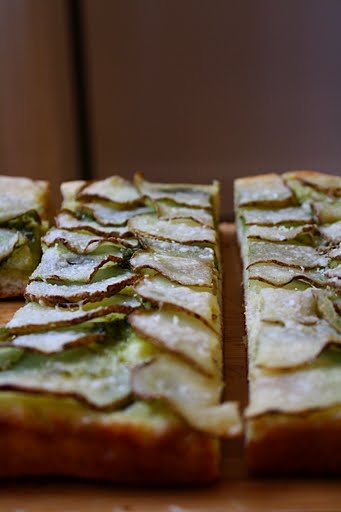 Inspired by a Log Lunch recipe, adapted from Gourmet 1990 via Epicurious. I made this for a dinner at Alexis' house with her mom and it was a big hit!
2 1/2 teaspoons active dry yeast
4 1/2 cups all-purpose and/or bread flour
2 cups mashed cooked russet potatoes (about 1 1/4 pounds)
1 tablespoon salt
2 garlic cloves, sliced thin
2 teaspoons chopped fresh rosemary (dried is ok too)
1/4 cup olive oil
1 1/2 pounds small red or purple potatoes
1. In a small bowl sprinkle the yeast over 1 cup warm water and let it proof for 5 minutes, or until foamy.
2. In a large bowl combine 4 cups of flour with the mashed potatoes and the salt until the mixture resembles coarse meal. Add the yeast mixture, and stir the dough until it is combined well.
3. Turn the dough out onto a floured surface and knead it, incorporating as much of the remaining 1/2 cup flour as necessary to prevent it from sticking, for 8 to 10 minutes, or until it is smooth and elastic. Form the dough into a ball, put it in an oiled bowl, and turn it to coat it with the oil. Let the dough rise, covered with plastic wrap, in a warm place for 1 1/2 hours, or until doubled.
4. While the dough is rising, in a small bowl stir together the garlic, the rosemary, and the oil and let the mixture stand, covered.
5. Turn the dough out into an oiled 15 1/2- x 10 1/2-inch jelly-roll pan, press it evenly into the pan, and let it rise, covered loosely, in a warm place for 30-45 minutes, or until it is almost double in bulk.
6. Using a mandoline or hand-held slicer cut the small potatoes into paper-thin slices, arrange the slices on the dough, overlapping them, and brush them with the oil mixture, discarding the garlic. Sprinkle the focaccia with salt and pepper to taste.
7. Bake it in the bottom third of a preheated 400°F. oven for 40 to 50 minutes, or until it is golden. Let the focaccia cool in the pan on a rack and serve it fresh out of the oven!
Sunday, March 21, 2010
Whole Wheat Muffins - The Master Recipe

From Mark Bittman's "The Minimalist" column in the NYTimes, Feb 10, 2010. Made for me for breakfast one morning from Auntie Deb in Minneapolis.
1/4 c (1/2 stick) melted unsalted butter
2 1/2 c whole wheat pastry flour, white whole wheat flour, or whole wheat flour (or a mix with some unbleached white flour)
3/4 c white or brown sugar (to taste) + more for sprinkling on top of muffins
2 t baking powder
1/4 t baking soda
1/4 t salt
1 1/2 c mashed or pureed banana, sweet potato, apple, zucchini, pumpkin, or other fruits or vegetables
1 egg, beaten
1/2 c buttermilk or yogurt
optional add-ins: 3/4 c chocolate chips, 1/2 c chopped walnuts or pecans, 2 T toasted wheat germ, 1 t cinnamon or other spice (Mark Bittman recommends banana-walnut, pumpkin-coconut, sweet potato-cardamom-ginger)
1. Preheat oven to 375 and grease muffin tins for 12 big muffins. In a large bowl, mix together the flour, sugar, baking powder, baking soda, and salt (and spices or other dry ingredients, if using). In another bowl, whisk together the melted butter, banana (or other fruit/veggie), egg, and buttermilk. Fold wet mixture into dry mixture and stir until just combined (add in any of the optional ingredients now).
2. Fill muffin tins or liners; sprinkle tops with sugar. Bake for about 25 minutes, or until muffins are puffed and turning golden brown on top. Serve warm if possible.
Yield: 12 muffins
Friday, December 18, 2009
Babkalicious
This is one of the most delicious Babka recipes I've tried, from Bernard Clayton's New Complete Book of Breads. Although the almond paste in the filling makes this recipe very moist, be warned that there is a strong almond flavor as well, which is different from most Babka recipes. With a few small revisions, here it is:
[two loaves: 2 8" cake pans, 2 medium loaf pans, or 1 baking sheet- all greased]
Sponge:
2 C unbleached white flour
2 packages of dry yeast, or 4 1/2 t yeast
1/2 C nonfat dry milk
1 1/4 C very warm water
Stir all ingredients together with a wooden spoon or in a mixer with a flat beater. It will be a heavy and wet dough. Cover tightly with a plastic bag and leave at room temperature to allow the sponge to form and ferment and double in bulk, about 2 hours.
Dough:
1/2 C sugar
1 t salt
1/2 t ground cardamom
1/2 t vanilla extract
2 eggs
2 egg yolks
2 1/2 C unbleached white flour, approximately
1/2 C (1 stick) butter, softened
Filling:
1 1/2 C almond paste
2 C chocolate chips or grated chocolate
ground cinnamon to taste
Mixing dough: remove plastic from the sponge, stir down, and measure in the sugar, salt, cardamom, and vanilla. Stir well to blend. Add the eggs and egg yolks, one at a time, beating each into the batter. Add 1 1/2 C flour and beat with a wooden spoon or flat beater until it has been absorbed into the batter-like dough. Drop in the butter, a small amount at a time, beating until it is mixed into the dough. Add flour, 1/4 C at a time, to form a dough that is quite soft, yet elastic. It will have enough flour when it can be turned from the bowl and be worked without it sticking to your hands or the table.
Kneading: Sprinkle the table lightly with flour, if necessary. Knead the dough only until it is smooth, about 5 minutes. (If using a mixer, use a dough hook.) Place the dough in a greased bowl, cover tightly again, and put aside to double in bulk, about 1.5 hours.
Shaping: Punch down and turn out on the floured table and divide into 2 pieces. Roll each to form a thin piece about 1/4" thick. Combine all the ingredients of the filling in a food processor is you have one- adjust to your liking, adding more chocolate, nuts, dried fruit, etc. Spread each rectangle with half the filling. Roll up the dough longwise, like for a jellyroll, and pinch the seas tightly to secure. Try to roll each snake a little bit longer.
For the cake pans, simply lay the twists loosely in the pan in a spiral form beginning in the center and working to the sides. For the loaf pans, fold the snakes at their halfway mark and twist them on themselves, kind of making a figure-eight formation, and lay in loaf pans or the baking sheet. Cover the loaves loosely and let rise not quite to double in bulk, about 1 hour.
Baking: 20 minutes before baking, preheat oven to 350. Brush the tops with melted butter or the leftover egg whites. Bake until each twist is deep brown, about 45 minutes. If the crusts seem to be browning too quickly, cover with foil. Remove loaves from pans and cool before cutting.
Wednesday, October 7, 2009
Zucchini Oat Bread
This recipe is healthy and hearty, and has great spices. Adapted from this blog: http://dlynz.com.

Preheat the oven to 350 degrees.
Grate enough zucchini to measure 2 cups
Mix in 1 teaspoon kosher salt
And 1 cup regular oats, and let sit for about 30 minutes. This will draw some of the moisture from the squash and allow the oats to absorb it, which will soften them up a bit.
In another bowl, whisk together:
3 1/2 cups flour (I suggest half white and half wheat)
3/4 cup granulated sugar
1 teaspoon baking powder
1 teaspoon baking soda
1 teaspoon cinnamon
1/2 teaspoon allspice
1/2 teaspoon cloves (optional)
1/2 teaspoon cardamom (optional)
Add to dry mixture: 1/2 cup chopped walnuts
Add to zucchini mixture:
3/4 cup dark brown sugar (light brown is ok)
3 eggs, slightly beaten
1/2 cup vegetable oil
2 teaspoon vanilla
1 tablespoon freshly grated ginger
1 tablespoon lemon zest
Mix the wet ingredients into the dry mixture, until combined. Divide evenly between 2 greased 5 x 8 bread pans. Bake for about 45 to 50 minutes. A toothpick inserted near the center should come out clean. Remove from pans and cool on a wire rack.
Preheat the oven to 350 degrees.
Grate enough zucchini to measure 2 cups
Mix in 1 teaspoon kosher salt
And 1 cup regular oats, and let sit for about 30 minutes. This will draw some of the moisture from the squash and allow the oats to absorb it, which will soften them up a bit.
In another bowl, whisk together:
3 1/2 cups flour (I suggest half white and half wheat)
3/4 cup granulated sugar
1 teaspoon baking powder
1 teaspoon baking soda
1 teaspoon cinnamon
1/2 teaspoon allspice
1/2 teaspoon cloves (optional)
1/2 teaspoon cardamom (optional)
Add to dry mixture: 1/2 cup chopped walnuts
Add to zucchini mixture:
3/4 cup dark brown sugar (light brown is ok)
3 eggs, slightly beaten
1/2 cup vegetable oil
2 teaspoon vanilla
1 tablespoon freshly grated ginger
1 tablespoon lemon zest
Mix the wet ingredients into the dry mixture, until combined. Divide evenly between 2 greased 5 x 8 bread pans. Bake for about 45 to 50 minutes. A toothpick inserted near the center should come out clean. Remove from pans and cool on a wire rack.
Tuesday, October 6, 2009
No Knead Four-Grain Honey Bread
Four Grain-Honey Bread
From Nancy Baggett, author of Kneadlessly Simple.
Four Grain-Honey Bread
- yields 1 large loaf -
Ingredients
2 cups (10 ounces) unbleached white bread flour, plus more as needed
1 cup (5 ounces) whole wheat flour
1/2 cup white or yellow cornmeal, preferably stone-ground, plus more for garnish
1/3 cup rolled oats, plus more for garnish
1/3 cup cooked and cooled brown rice (I used cooked barley!)
Generous 1 1/2 teaspoons salt
3/4 teaspoon instant, fast-rising, or bread machine yeast
1/2 cup clover honey or other mild honey
1 1/4 cups ice water, plus more if needed
Corn oil or other flavorless vegetable oil for coating dough top and baking pan
Procedure
First rise: In a large bowl, thoroughly stir together the bread flour, whole wheat flour, cornmeal, oats, brown rice, salt, and yeast. In another bowl or measuring cup, thoroughly whisk the honey into the ice water. Vigorously stir the mixture into the bowl with the flours, scraping down the bowl sides and mixing just until the dough is thoroughly blended. If the ingredients are too dry to mix together, gradually add in just enough more ice water to facilitate mixing; don't over-moisten, as the dough should be stiff. If necessary, mix in more bread flour to stiffen it. Brush or spray the top with oil. Tightly cover the bowl with plastic wrap. If desired, for best flavor or for convenience, refrigerate for 3 to 10 hours. Then let rise at cool room temperature for 12 to 18 hours; if convenient, stir once during the rise.
Second rise: Vigorously stir the dough. Using a well-oiled rubber spatula, fold the dough in towards the center, all the way around the bowl. Dust an oiled 9x5-inch loaf pan with 1 tablespoon each cornmeal and rolled oats, tipping it back and forth to coat the pan sides. Turn out the dough into the pan. Brush or spray the top with oil. Smooth out the top and press the dough into the pan with oiled fingertips or a rubber spatula. Sprinkle 1/2 tablespoon each cornmeal and rolled oats over the top. Press down to imbed. Cut four or five 3-inch-long, 1/4-inch-deep evenly spaced slashes diagonally across loaf top. Cover the pan with nonstick spray-coated plastic wrap.
Let rise using any of these methods: For a 2- to 4-hour regular rise, let stand at warm room temperature; for a 1 1/2- to 2 1/2-hour accelerated rise, let stand in a turned-off microwave oven along with 1 cup of boiling-hot water. Or, for an extended rise, refrigerate for 4 to 24 hours, then let stand at room temperature. Remove the plastic when the dough nears it, then continue the rise until the dough extends 1/2 inch above the pan rim.
Baking preliminaries: 15 minutes before baking time, put a rack in the lower third of the oven; preheat to 350°F.
Baking: Bake on the lower rack for 50 to 60 minutes, or until the loaf is well browned and firm on top; cover with foil if necessary to prevent over-browning. Continue baking for 10 to 15 minutes longer, testing until a skewer inserted in the thickest part comes out with just a few particles on the end (or until the center registers 207 to 209°F on an instant-read thermometer). Bake for 5 to 10 minutes more to ensure the center it done. Cool in the pan on a wire rack for 10 minutes. Turn the loaf onto the rack; cool thoroughly.
Serving and storing: Cool thoroughly before slicing or storing in a plastic bag or foil. The bread will keep at room temperature for 2 to 3 days, and may be frozen, airtight, for up to 2 months.
Saturday, October 3, 2009
Bread Machine Challah
Everyone in my family has his or her own version of bread machine challah. Mom's might have some leftover oatmeal, mashed potatoes, or bran flakes in it; Tova's might be rosemary-lemon (thank you WSM) or 7-grain vegan. This recipe is for a straight-forward half-white/half-wheat challah, with a touch of honey. Adapted from http://koshercamembert.wordpress.com.
Makes one big or two small challahs.
1 1/8 cup warm water
1/4 cup vegetable oil
2 eggs
2 T honey
1/8 cup sugar
1 t salt
4 cups flour (2 cups white and 2 cups wheat)
2-3 t vital wheat gluten (optional - helps the bread rise)
1 packet dry yeast (2 1/4 t)
additional egg for egg wash
1. Measure wet ingredients into bread machine bowl - water, oil, eggs, and honey. Make sure the water is warm but not hot, to activate the yeast without cooking the eggs.
2. Add the sugar, salt, and flour(s). Make sure that the salt is under the flour because you don't want it to touch the yeast. Make a well in the center of the flour and pour the yeast into the well.
3. Put the bowl into the bread machine and set to "dough" setting.
4. When the dough cycle is done, punch it down (this is my favorite part) and invert onto a lightly-floured counter. Knead the dough a little bit and add more flour if needed. Preheat the over to 350 degrees.
5. Divide and braid the dough into 1 or 2 challahs! See the bottom of the poast for how to make a 4-stranded braid.
6. After loaves are formed, place on a lightly greased and floured cookie sheet (you can use a Silpat). Allow to rise again on top of pre-heating oven, covered with a clean cotton towel.
7. Make an egg wash by beating 1 egg with 1 t cold water. Brush this mixture over the challah with a pastry brush - do this once before the challah goes in the oven and once about 10 minutes after the challah has been in the oven.
8. Bake for 20-30 minutes until the challah is golden brown (if you're like me and like your challah a little bit doughey, don't cook it for more than 25 minutes).
9. Cook on a baking rack and serve warm!
TO MAKE A 4-STRANDED BRAID:
Always braid from one direction (either right or left, doesn't matter, just be consistent). Place "outside" strand (A) over second strand (B), under third strand (C), and then over fourth strand (D). The new "outside" strand (B) goes over (C), under (D), and over (A). Then the new "outside" strand (C) goes over (D), under (A), and over (B), etc.
Makes one big or two small challahs.
1 1/8 cup warm water
1/4 cup vegetable oil
2 eggs
2 T honey
1/8 cup sugar
1 t salt
4 cups flour (2 cups white and 2 cups wheat)
2-3 t vital wheat gluten (optional - helps the bread rise)
1 packet dry yeast (2 1/4 t)
additional egg for egg wash
1. Measure wet ingredients into bread machine bowl - water, oil, eggs, and honey. Make sure the water is warm but not hot, to activate the yeast without cooking the eggs.
2. Add the sugar, salt, and flour(s). Make sure that the salt is under the flour because you don't want it to touch the yeast. Make a well in the center of the flour and pour the yeast into the well.
3. Put the bowl into the bread machine and set to "dough" setting.
4. When the dough cycle is done, punch it down (this is my favorite part) and invert onto a lightly-floured counter. Knead the dough a little bit and add more flour if needed. Preheat the over to 350 degrees.
5. Divide and braid the dough into 1 or 2 challahs! See the bottom of the poast for how to make a 4-stranded braid.
6. After loaves are formed, place on a lightly greased and floured cookie sheet (you can use a Silpat). Allow to rise again on top of pre-heating oven, covered with a clean cotton towel.
7. Make an egg wash by beating 1 egg with 1 t cold water. Brush this mixture over the challah with a pastry brush - do this once before the challah goes in the oven and once about 10 minutes after the challah has been in the oven.
8. Bake for 20-30 minutes until the challah is golden brown (if you're like me and like your challah a little bit doughey, don't cook it for more than 25 minutes).
9. Cook on a baking rack and serve warm!
TO MAKE A 4-STRANDED BRAID:
Always braid from one direction (either right or left, doesn't matter, just be consistent). Place "outside" strand (A) over second strand (B), under third strand (C), and then over fourth strand (D). The new "outside" strand (B) goes over (C), under (D), and over (A). Then the new "outside" strand (C) goes over (D), under (A), and over (B), etc.
Wednesday, May 13, 2009
2 recommended recipes from Deb/Susan Bishop
Goat Cheese with Olives, Lemon, and Thyme


File this one under "secret weapon" and pull it out whenever you need a quick but impressive appetizer. Warming the olives in thyme- and-lemon-zest-infused oil awakens their flavor and transforms a goat-cheese medallion into a sumptuous warm spread for flatbread.
Yield: Makes 4 (hors d'oeuvre) servings
1/2 cup assorted olives
3 fresh thyme sprigs
3 tablespoons extra-virgin olive oil
1/2 teaspoon grated lemon zest
1 (4- to 5-ounce) fresh goat-cheese medallion or 2 (2-ounces) goat-cheese buttons
Heat olives, thyme, oil, zest, and 1/4 teaspoon pepper in a small skillet or saucepan over low heat until fragrant (do not simmer). Cool to room temperature. Serve olive mixture over goat cheese.
Crisp Rosemary Flatbread

Think of it as a cracker version of rosemary-flecked flatbread. But these are the easiest crackers you'll ever make: Rather than cutting the dough into small pieces, you bake three large pieces, then break them into smaller ones to serve. The jagged edges invite nibbling. (From Gourmet 2008)
Yield: Makes 4 servings
1 3/4 cups unbleached all-purpose flour
1 tablespoon chopped rosemary plus 2 (6-inch) sprigs
1 teaspoon baking powder
3/4 teaspoon salt
1/2 cup water
1/3 cup olive oil plus more for brushing
Flaky sea salt such as Maldon
Preheat oven to 450°F with a heavy baking sheet on rack in middle.
Stir together flour, chopped rosemary, baking powder, and salt in a medium bowl. Make a well in center, then add water and oil and gradually stir into flour with a wooden spoon until a dough forms. Knead dough gently on a work surface 4 or 5 times.
Divide dough into 3 pieces and roll out 1 piece (keep remaining pieces covered with plastic wrap) on a sheet of parchment paper into a 10-inch round (shape can be rustic; dough should be thin).
Lightly brush top with additional oil and scatter small clusters of rosemary leaves on top, pressing in slightly. Sprinkle with sea salt. Slide round (still on parchment) onto preheated baking sheet and bake until pale golden and browned in spots, 8 to 10 minutes. Transfer flatbread (discard parchment) to a rack to cool, then make 2 more rounds (1 at a time) on fresh parchment (do not oil or salt until just before baking). Break into pieces.
Subscribe to:
Posts (Atom)